Community / Users list / Giliolbran

Giliolbran
Live roulette online in Great Britain: rules and safety
# Live roulette casino online in Great Britain
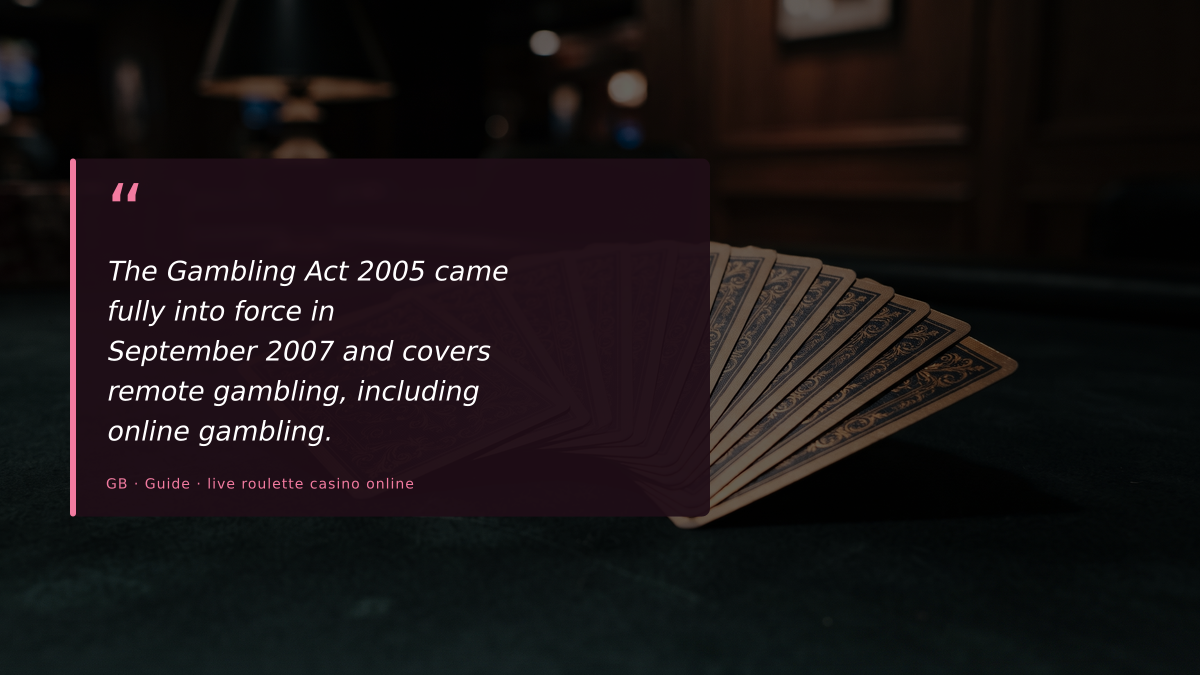
Live roulette casino online sits under the UK Gambling Commission framework in Great Britain and is treated as remote casino gambling. The term matters, since remote gambling means play by remote communication, and that places the product inside a clear licensing and tax system rather than an informal space.
The main point for players is not glamour but control. A licensed operator must work within the rules set by the Gambling Act 2005, and the regulator can act on licence breaches, data reporting, safer gambling failures, and other conduct that affects British customers.
For many players, live roulette feels closer to a table in a physical casino than standard slot play. The dealer is real, the wheel is real, and the stream is live, yet the protections around payments, self-exclusion, and account checks still matter more than the table mood.
## What does live roulette mean under UK rules?
Live roulette online is a form of remote casino gambling. It uses live video and remote communication, so the law treats it as online gambling rather than as a land-based game merely shown on screen.
The Gambling Commission is the statutory body that issues gambling licences for regulated activity in Great Britain. That licence is not a decoration. It sits behind the operator’s right to offer the game and behind the duty to keep records, report data, and follow the rules that protect customers.
Remote gambling also has a tax side. Operators serving UK customers can owe Remote Gaming Duty even when the company is based outside the UK, and the UK government review says that the sector is taxed on profits from Great Britain customers no matter where the company is based. Separate gambling duties are collected by HMRC, apart from licence fees paid to the Gambling Commission.
That structure matters for players who want clear oversight. A live roulette table may look simple, yet the legal position behind it is not simple at all, and the British framework gives the regulator a direct role in supervision.
## Which payment methods fit the GB market?
Payments should match the local market and the legal rules that govern it. In Great Britain, debit cards remain the standard card route for gambling, while PayPal, Apple Pay, and Paysafecard are common names that many customers recognise and use with care.
Credit cards are banned for gambling in the UK, so they should not be suggested or used as a normal option for a live roulette deposit. A cautious player checks the payment page, the banking terms, and the method’s own limits before any money moves.
* Debit cards for direct bank-linked payments.
* PayPal for a widely used digital wallet route.
* Apple Pay for mobile payments where offered.
* Paysafecard for prepaid spending control.
Payment choice should be shaped by control, not speed alone. A customer who wants live roulette for occasional play may prefer a method that limits spend more clearly, and a prepaid option can suit that need better than a card linked to everyday bills.
Affordability checks are part of the British setting, too. Operators can ask for evidence about spending power when the pattern of play suggests a risk, and that process exists to reduce harm rather than to slow play for its own sake.
## How does player protection work in practice?
One clear mechanism stands out: GamStop self-exclusion. It is the national online self-exclusion scheme for online gambling in Great Britain, and once a person joins, licensed online operators must respect that block across participating sites.
That single tool can make a real difference. A player who feels pressure around football bets, horse racing, or live casino play can step away from the market for a set period instead of relying on willpower alone at the table.
The current numbers show why the tool remains relevant. GamStop reported a 16% year-on-year increase in registrations in the first half of 2026, and registrations among under-25s rose 26% in the same period. GamStop also said under-25s now make up nearly one in three of all self-exclusions.
Checks on affordability sit beside self-exclusion. They are not there for show. They are part of a safer gambling framework that asks whether the spend looks proportionate, and they can sit alongside time-out tools, deposit limits, and account reviews.
Live roulette can look fast and harmless in short bursts, yet the risk is not only about one spin. Repeated play can turn a small stake into a pattern that is hard to manage, so protection tools should be taken seriously rather than treated as a box-ticking exercise.
## What should players look for on a licensed site?
A licensed site should show clear terms, clean payment routes, and plain account controls. The live roulette product itself may be the draw, but the safer part of the visit is the structure around it: registration, verification, spending controls, and access to help if play stops feeling controlled.
The market overview from the Gambling Commission gives a sense of scale. Its latest data to March 2026 shows total online Gross Gambling Yield rose 7% year on year to £1.55 billion, and the remote casino, bingo and betting sector in Great Britain employs around 10,000 people.
Those figures do not tell a player whether one table is suitable, but they do show that the sector is large and closely watched. That matters when money is being staked in pounds, especially on a live game where the pace can tempt a person to chase losses.
* Check that the operator names the Gambling Commission licence position clearly.
* Read the banking terms before the first deposit.
* Look for deposit limits, time-out tools, and self-exclusion access.
* Confirm that GamStop links are easy to find.
* Use affordability checks as a warning sign, not an obstacle.
Good practice is plain here. A player should not treat a live dealer stream as a substitute for due care, and a regulated casino should make the control tools easy to reach without forcing the customer through extra steps.
## Where do taxes and duties sit in the picture?
The tax position helps explain why regulated live roulette is not a loose online hobby category. Operators offering remote gaming to UK customers are liable for Remote Gaming Duty even if they are based outside the UK, and that duty is charged at 21% of gross gaming revenues from remote gaming transactions with UK customers.
Gaming Duty is separate from Remote Gaming Duty and applies to casino gaming done in the UK, with returns and payment due for each 6-month accounting period. The Gambling Act 2005 review also states that separate gambling duties are collected by HMRC, apart from licence fees paid to the Gambling Commission.
This matters for accountability, since tax and licence rules create trails. A player does not need to master the full system, but it helps to know that the live roulette table is part of a taxed and supervised market rather than a free-floating service without a British legal anchor.
That legal anchor is one reason many players prefer licensed sites over uncertain alternatives. A compliant operator must balance business needs with duties on reporting, safer gambling, and customer checks, and that balance is part of the ordinary cost of offering the product in Great Britain.
For a practical example, a player who reaches a live casino through [musbet casino](https://musbetcasino.net/) should still apply the same checks as with any other site: licence position, payment method, self-exclusion access, and the clarity of the rules before any stake is placed.
## Why does responsible play matter with live roulette?
Live roulette is simple to explain and easy to keep playing. That combination can mask risk, since the game gives fast feedback and quick chances to stake again, which can lead to repeated deposits if the player is not watching time and spend.
Responsible play is not a slogan here. It means using the tools that already exist, keeping gambling money separate from everyday money, and treating a live table as entertainment with a cost rather than a way to recover losses.
British players also need to remember that football and horse racing can sit beside casino play in the same account, so exposure is not limited to one product. A person who already feels stretched by sports betting may find live roulette adds pressure rather than variety.
The safest habit is to set a limit before the session begins and stop when the limit is reached. If control starts to slip, self-exclusion, including GamStop where needed, is the proper response, not a sign of failure.
Live roulette online in Great Britain sits inside a licensed, taxed, and watched market. The rules around the Gambling Commission, GamStop, affordability checks, and banned credit cards form the main protection, and a careful player should treat them as part of the game rather than as fine print.


