Community / Users list / dietercohrs

dietercohrs
Tackling online casino withdrawal problems in Great Britain
# Tackling online casino withdrawal problems in Great Britain
The Gambling Commission requires licensed operators to let players withdraw money from a deposit balance, including winnings, yet online casino withdrawal problems UK often start with bonus terms or account checks. A payout can become slow when a payment method, a verification step or a self-exclusion setting changes how the account is reviewed.
The Gambling Commission reported 38% of adults had participated in online gambling in the previous four weeks, and that makes a delayed cash out a common consumer issue rather than a rare complaint. A player checking account terms may use the [highstack login](https://high-stack.net/) page and then read the withdrawal rules.
The core GB gambling law, the Commission’s Licence Conditions and Codes of Practice set duties for payouts, fair terms plus customer funds. Consumer contract law in Great Britain can apply where withdrawal terms feel one-sided or unreasonably restrictive.
Market numbers help explain why withdrawal talk appears in ordinary consumer speech. The Gambling Commission reported that 59% of adults in Great Britain participated in any gambling in the previous 12 months. For many of those people, the question is not whether the law exists, but how quickly money moves when a payout request reaches the account screen.
## Check the deposit balance and bonus terms
Withdrawal disputes often turn on the difference between a deposit balance and a bonus balance. The deposit balance is the regulated term the Gambling Commission uses when it says players may withdraw money, including winnings, at any time. A football accumulator, a horse racing winnings ticket or a slot spin that has cleared can all end up inside that same regulated pool.
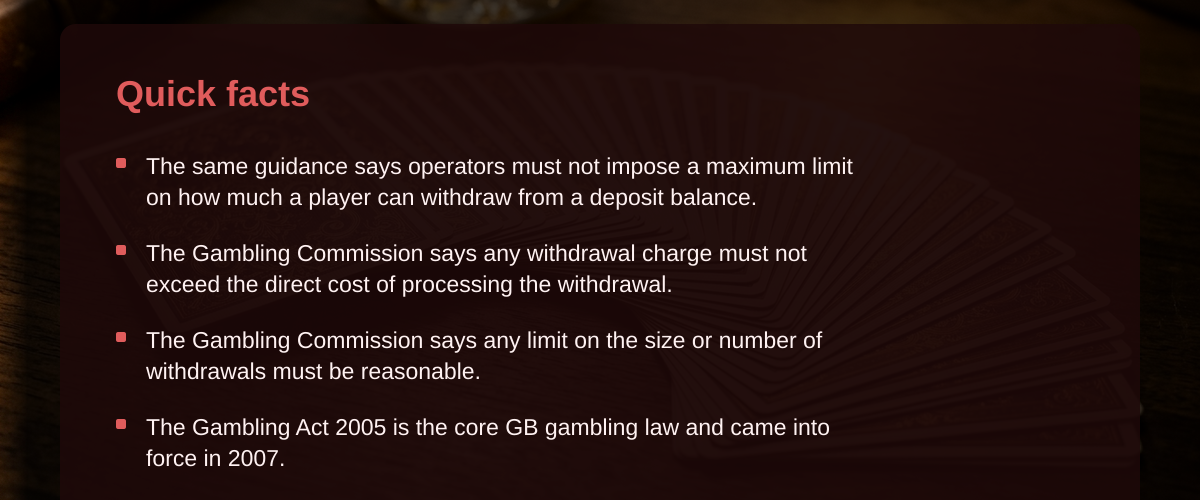
Operators must not place a maximum limit on how much a player can withdraw from a deposit balance. A withdrawal charge may exist, but it cannot exceed the direct cost of processing the transfer. Any limit on the size or number of withdrawals must be reasonable. Those rules give players a clear way to judge whether a stalled payout sits with the operator or with a payment method.
Fair terms should tell a player how long verification may take, whether bonus funds are separate, which payment route applies, whether a withdrawal charge exists, whether a limit on withdrawal size or number applies.
A colour-coded account balance may not make the distinction obvious. A plain figure beside the deposit balance is more useful than a vague message about pending review.
A player can check which details appear on the account screen:
* the deposit balance,
* the bonus balance,
* the withdrawal charge,
* the payment method,
* the last verification date.
Bonus wagering can confuse the picture. If a player has not finished the wagering that applies to a bonus, the operator may treat some funds as outside the deposit balance until the condition is met. A complaint may not be about a refusal at all when the account still sits in an intermediate state. A clear account screen should show that state without forcing a player to guess.
## Verify payment methods and identity checks
Payment routes shape the speed of a withdrawal. In Great Britain, bank transfer, debit card, PayPal, Apple Pay, Google Pay and prepaid options are commonly used payment methods for online gambling. Debit cards, PayPal, Apple Pay and Paysafecard are the choices most familiar to British players. Credit cards are banned for gambling products, so a payout cannot be routed through that channel.
A withdrawal charge needs a direct reason. The Commission says it cannot exceed the cost of processing the payout. A player can ask for that cost when a fee appears, not just the final amount after the fee.
Identity checks have a narrow role. The Gambling Commission says operators may carry out identity verification or other checks before withdrawal only when strict regulatory obligations make them necessary. That wording rules out routine delays added to slow a lawful payout.
Affordability checks and safer gambling reviews are standard controls. A player who has used the site during a football season or around a horse racing fixture may see a payment reviewed when stakes rise, deposits repeat or winnings create a sudden change in activity. The review is meant to protect the customer, yet it can feel like a blockage when the account holder simply wants cash out.
Where a payment method is slow, the reason often sits outside the casino. A bank transfer can pass through processing queues. A PayPal or Apple Pay review can add steps. A debit card return can depend on the card issuer. The operator still needs to explain the status with clear dates and a named contact, not with a vague promise of speed.
A debit card withdrawal may look like a card refund, but it must be treated as the return of gambling funds. A PayPal route can be familiar for football accounts or horse racing wallets. Apple Pay can reduce card detail sharing at the deposit stage. Paysafecard often suits a player who wants prepaid controls, though the operator can show the outgoing route plainly.
## Review self-exclusion and safer gambling rules
GAMSTOP gives consumers a free national route to exclude themselves from online gambling websites plus apps licensed in Great Britain. The scheme applies to online services, not physical betting shops or casinos. A person using it can expect licensed operators to block new account activity, yet funds held inside an existing account remain subject to the same withdrawal rules.
The Safer Gambling team at the Gambling Commission requires licensed operators to offer self-exclusion tools plus safer gambling controls. That requirement gives operators a duty to notice when a customer asks to stop gambling and still keep the money trail clear. A self-exclusion can make support requests slower, though it does not erase a player’s right to withdraw a deposit balance.
If a player has already been blocked or closed off by an operator, the first useful step is to find out whether the account itself was closed or only restricted from new play. A closed account can change the support route for remaining funds. A restricted account may leave the balance available. The distinction matters, and a withdrawal request can fail when the wrong route is used.
A practical account note can help here. A player can keep a plain record of the date of GAMSTOP use, the operator’s acknowledgement date, the amount waiting in the deposit balance. A clear timeline makes a later complaint easier to read.
During big race meetings or football fixtures, a player may move between betting accounts and casino games. That activity pattern can raise safer gambling checks. The check is not meant to confiscate winnings, though it can hold a payout while the operator reviews account history.
## Apply consumer contract protections

The core GB gambling law created the regulatory system that now governs betting plus casino services. It came into force after the Gambling Act’s passage. The Gambling Commission licenses operators that meet its rules. That system sits beside ordinary consumer contract law, where unfair terms can be challenged. A withdrawal rule that feels lopsided can be a licensing issue or a contract issue.
The Commission’s current consumer protection framework is based on the Licence Conditions and Codes of Practice, including rules on withdrawals plus fair terms. Operators have to keep terms clear enough for a customer to understand. A hidden cap on cash out, a long delay without reason, or a charge above processing cost would all be hard to defend under those rules.
Customer fund protection adds another layer. The Gambling Commission’s rules use protection categories, and category 3 offers the weakest protection with no segregation requirement. A player checking where money sits can see that protection is not the same as a guarantee that every transfer will finish quickly.
Market size helps explain why regulators pay attention. A recent Gambling Commission market report gave total customer-facing gambling industry Gross Gambling Yield as £17.5 billion. The same report found 16% of adults had gambled online in the previous four weeks when lottery draw-only players were excluded. Those figures make clear that a small number of withdrawal terms can affect millions of pounds.
Stake limits show how the Commission can step into consumer risk. The Gambling Commission introduced a £5 stake limit for online slots for all adults, then a £2 stake limit for adults aged 18 to 24. Those rules may affect gameplay first, though a player who already has money in the account still needs a reasonable path to withdrawal.
Terms can look fair on paper and still move slowly in practice. A company may list verification steps without saying which step triggers a delay. A customer then needs a status update that names the step, not a generic promise of progress.
## Read local market realities around delays
A British week can mix several betting habits. A football result may be followed by a quick casino spin. A horse racing bet settled through a betting account may be moved to an online casino wallet. Those routes can leave a deposit balance that is lawful, yet still tied to a support workflow the player has never used.
The survey point shows online participation is broad. The Commission found 38% had participated in online gambling in the previous four weeks, a figure high enough to make payout complaints a mainstream retail issue rather than a niche casino matter.
Local payment habits matter. Debit cards, PayPal, Apple Pay and Paysafecard are familiar retail routes; PayPal plus Apple Pay can feel quickest for small transfers. Debit cards remain a favourite route, while Paysafecard can appeal to a player who wants prepaid controls. A player may expect gambling funds to behave like a marketplace payment. That expectation can collide with safer gambling checks, identity rules plus fund protection terms, producing a withdrawal problem that feels personal but is partly structural.
## Escalate unresolved cases through the right channels
When a withdrawal stalls, the operator needs a written request with details, not just a chat window. A clear message can state the date, the amount, the payment method, the deposit balance shown, the withdrawal charge, if any. It can quote the Gambling Commission’s rule against a maximum limit on withdrawals from a deposit balance. It can ask whether the funds are held in a bonus balance or a restricted account.
The next step depends on the answer. If an operator admits the payout was delayed by verification, the player can ask what checks remain, when they will finish. If an operator says the bonus terms block the funds, the player can ask for the exact clause, the date the wagering requirement ended. If an operator says a self-exclusion closed the account, the player can ask for the balance transfer route, any charge.
> A deposit balance, including winnings, can be withdrawn without a maximum cap, while bonus terms may decide when money moves out of a restricted state.
Players can compare the operator’s answer against the rules that apply. Identity checks may be used only when strictly necessary for regulatory obligations. Withdrawal charges cannot exceed direct processing costs, plus limits on withdrawal size or number must be reasonable. A reply that ignores those points may need a higher review.
A complaint that reaches a reviewer can carry a full record. The record can include the account statement, the support thread, the verification request, the payment receipt, the withdrawal screen at the moment it failed. A complete file gives a reviewer something to check against, not just a frustrated voice.
Plain language works better than urgency. A reviewer needs to see when the request happened, what money was involved, where the money can go, how the operator answered.


