Community / Users list / ElodieHarrington

ElodieHarrington
Online Casino Quick Payout Rules and Methods in the UK
# What Defines an Online Casino Quick Payout for British Players?

The concept of an online casino quick payout carries specific weight in the British gambling market. For players, it signifies the timely receipt of winnings without undue administrative delay. The operational reality behind this promise is shaped by a strict regulatory framework designed to protect consumer funds while preventing financial crime. Speed is often a function of payment method, internal processing efficiency, and mandatory compliance checks.
Funds that leave a casino's accounts within several hours and reach the player within the same or next working day typically qualify as a fast withdrawal in local market terminology. This expectation is underpinned by rule 5.1 of the Gambling Commission's Licence Conditions and Codes of Practice, which states that licensees must not impose unreasonable barriers or undue delay on withdrawals. The pursuit of a rapid transaction, however, remains secondary to the compulsory identity verification required before any first withdrawal is processed, a core tenet of UK anti-money laundering rules.
Several established payment channels facilitate these quicker transfers. E-wallets like PayPal, Skrill, and Neteller are commonly associated with expedited processing. Debit card withdrawals utilising the Visa Fast Funds scheme are also frequently marketed as offering near-instant receipt of funds, though actual speed depends on the issuing bank. It is critical to note that the use of credit cards for gambling deposits and withdrawals is comprehensively banned for transactions involving UK-licensed operators, a prohibition enforced by the Gambling Commission.
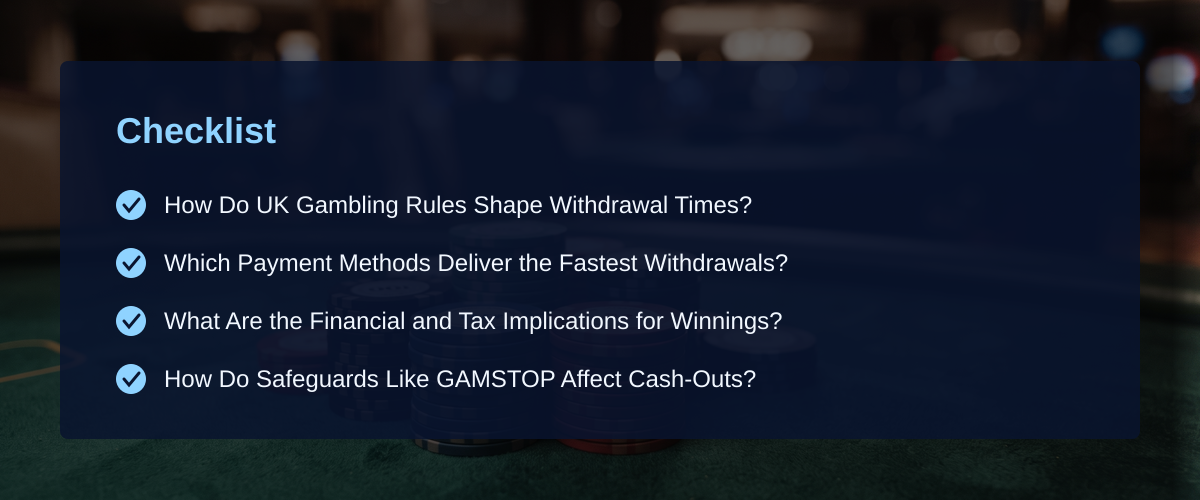
## How Do UK Gambling Rules Shape Withdrawal Times?
The regulatory architecture governing payouts is built upon the Gambling Act 2005. This legislation sets licensing objectives to prevent crime, ensure gambling is fair and open, and protect children and vulnerable people. The [Gambling Commission](https://www.gamblingcommission.gov.uk) acts as the primary regulator, issuing the Licence Conditions and Codes of Practice (LCCP) which forms the rulebook for all licensed operators. Its requirements directly impact the pace at which withdrawals can be completed.
Prior to any gambling activity, a UK-licensed site must verify a customer's age and identity. A more thorough identity confirmation is mandated before the first withdrawal request can be fulfilled. This process, while potentially adding hours or a day to the initial cash-out, is a non-negotiable standard. Operators must conduct these checks promptly; deliberate stalling would breach the LCCP's requirement against undue delay. The framework is designed to balance consumer convenience with robust financial safeguards.
Player protection mechanisms also influence account liquidity and withdrawal readiness. Affordability checks, increasingly standard practice, may assess a customer's financial activity before processing large withdrawals. Every UK-licensed operator is required to participate in the GAMSTOP national online self-exclusion scheme. A single GAMSTOP registration blocks an individual from accessing all licensed gambling websites in Great Britain, immediately freezing any withdrawal processes until the exclusion period ends.
## Which Payment Methods Deliver the Fastest Withdrawals?
Transaction speed varies significantly by payment channel, with e-wallets generally leading the market for an online casino quick payout. These digital accounts act as intermediaries, holding player funds separately from the gambling operator. When a withdrawal is requested, the casino transfers the money to the e-wallet provider, which then credits the user's e-wallet balance. This typically occurs within a few hours. The player can then transfer funds from their e-wallet to their bank account, a separate step that may also be instant or take a business day.
Debit card withdrawals, particularly those using the Visa Fast Funds infrastructure, offer another route for rapid access. The service enables push payments directly to the customer's card account, often within minutes of the casino authorising the transaction. Not all banks support this feature, and processing may only occur on business days. Traditional card refunds, which process a withdrawal as a reversal of the original deposit, can take three to five working days to appear on a statement.
Bank transfers and cheques sit at the slower end of the spectrum, often requiring several business days for clearance. The dominance of certain methods in the GB market is clear. Debit cards, PayPal, Apple Pay, and Paysafecard are prevalent for deposits, and their availability often mirrors withdrawal options. A site like [vegasland casino](https://vegaslanduk.uk/) would typically integrate these popular channels, though its specific processing times would be detailed in its own terms and conditions.
| Payment Method | Typical Withdrawal Timeframe | Key Considerations for GB |
| --- | --- | --- |
| E-wallets (PayPal, Skrill) | Several hours to 24 hours | Funds arrive in e-wallet first; separate transfer to bank may be needed. |
| Visa Fast Funds (Debit Card) | Minutes to a few hours | Dependent on bank support; credit cards are prohibited for gambling. |
| Standard Debit Card Processing | 1-3 business days | Often processed as a refund to the original deposit card. |
| Bank Transfer | 2-5 business days | Subject to banking hours and clearing cycles. |
## What Are the Financial and Tax Implications for Winnings?
A significant advantage for gamblers in the United Kingdom is the tax treatment of winnings. Gambling profits are generally not considered taxable personal income for the player. This principle means that a substantial online casino quick payout remains entirely in the hands of the recipient, with no obligation to declare it to HM Revenue and Customs. The financial liability falls on the operator, not the customer.
Remote gambling operators serving UK residents must register with HMRC and pay Remote Gaming Duty on their profits generated from British customers. The duty applies to remote gambling offered to people who usually live in the UK, with payments required in sterling. The standard accounting period for this duty is quarterly, ensuring the Treasury receives its due from licensed commercial operations. This system removes a layer of administrative complexity for the end-user, who can focus on the net amount received.
Player funds are also subject to protection rules. The Gambling Commission requires licensees to segregate customer money from operational funds, safeguarding the cash for payout purposes. In the event of operator insolvency, this measure provides a degree of protection for outstanding balances. The effectiveness of this segregation is a key factor in the overall security of the gambling ecosystem, as highlighted in the regulator's latest industry statistics covering the period up to March 2026.
## How Do Safeguards Like GAMSTOP Affect Cash-Outs?
Self-exclusion schemes are a cornerstone of responsible gambling policy in Britain, directly interfacing with withdrawal processes. GAMSTOP is the national scheme for online self-exclusion, mandated by the Gambling Commission for all UK licensees. When a person registers with GAMSTOP, their details are shared across the licensed industry, triggering an account block at every participating site. This action is comprehensive and designed to be a firm barrier.
The immediate effect on withdrawals is a freeze. Once self-excluded, a player cannot access their account to request a withdrawal. Licensed operators are required to handle the accounts of self-excluded customers in a specific manner, which includes returning any outstanding balances. The process for returning these funds is stipulated by the regulator and must be completed promptly, though it may involve direct contact from the operator's finance team rather than a standard customer-initiated transaction.
This interplay between consumer protection and financial access underscores a market where safety protocols can temporarily override convenience. The [NHS — Gambling addiction support](https://www.nhs.uk/live-well/addiction-support/gambling-addiction/) service provides a public-health resource for individuals who feel gambling is affecting their wellbeing, offering guidance distinct from the transactional mechanics of self-exclusion. These structures exist to ensure that gambling remains a leisure activity without harmful consequences, a licensing objective that takes precedence over the speed of any single transaction.
## What Should Players Verify Before Expecting a Fast Payout?
A proactive approach is necessary for any player prioritising withdrawal speed. The first step is to complete all identity verification requirements immediately after registration, long before a first withdrawal is needed. Submitting clear copies of a passport, driving licence, and a recent utility bill or bank statement accelerates the mandatory check. Delaying this until cashing out will inevitably introduce a pause of at least several hours, if not a full day.
Scrutinising the cashier section for method-specific limits is equally important. Every payment channel will have minimum and maximum withdrawal amounts per transaction and often per day or week. These figures are set by the operator and should be clearly published. A request for an amount outside these limits will be rejected or modified, causing delay. Some bonus promotions attach wagering requirements that must be met before the associated funds become eligible for withdrawal, a standard condition across the industry.
Finally, understanding the operational definition of "processing time" is useful. An operator may state that withdrawals are processed within 24 hours. This typically refers to the time their finance team takes to approve and action the request, not the subsequent time required for the banking network or e-wallet provider to deliver the funds. The total elapsed time from request to receipt is the metric that matters to the player. Checking independent reviews and forum feedback can provide real-world data on whether a site's advertised timelines match practical experience, though the mandatory regulatory steps remain a constant for all licensed entities.


