Community / Users list / ElwinEttinger

ElwinEttinger
Operational standards for jackpot games casino activities in Great Britain
==========================================================================

The gambling sector in Great Britain operates under one of the most structured legal frameworks in the global market. Every operator providing jackpot games casino services to British residents must adhere to stringent codes of conduct designed to preserve the integrity of the industry. These rules are not merely suggestions but statutory requirements that dictate how games are presented, how funds are handled, and how winners are paid. By prioritising clarity, the regulator ensures that the environment remains transparent for all participants, whether they are engaging in casual spins or participating in high-stakes pools.
Consumer safety acts as the foundation of all local gambling legislation, particularly concerning products with large potential payouts. The presence of a domestic licence indicates that a business has undergone rigorous vetting of its finances, technical systems, and ownership structure. In a market where online betting and gaming generated a Gross Gambling Yield of £7.8 billion in the year to March 2026, the scale of operations necessitates a high level of oversight. This volume of activity underscores the importance of having a centralised authority to monitor transaction flows and game fairness across all digital platforms.
Jackpot mechanics often involve complex mathematical models that must be verified by independent testing houses before they reach the public. These tests ensure that the advertised Return to Player (RTP) percentages are accurate and that the Random Number Generators (RNG) function without bias. For the millions of active accounts registered in Great Britain, these technical safeguards provide the necessary assurance that the digital interface matches the mathematical reality of the game. Compliance experts focus on these details to ensure that every spin or bet is recorded and settled according to the established rules of the specific title.
Financial security remains a primary concern for the regulator, leading to strict rules regarding how player funds are protected. Licensees must disclose the level of protection they offer for customer balances, categorised as basic, medium, or high. This transparency allows individuals to understand whether their money is legally segregated from the company’s operational accounts in the event of insolvency. Such measures are vital in maintaining public trust within a sector that saw 26.1 billion individual bets or spins in a single quarter during late 2026.
Role of the Gambling Commission
-------------------------------
The UK Gambling Commission (UKGC) serves as the sole statutory body responsible for regulating commercial gambling in Great Britain. Established under the Gambling Act 2005, its primary duties involve preventing gambling from being a source of crime, ensuring that gambling is conducted in a fair and open way, and protecting children and vulnerable people. Every remote operator must hold a Gambling Commission licence to legally offer services to consumers in the United Kingdom, a requirement reinforced by the Gambling (Licensing and Advertising) Act 2014. The regulator possesses the power to issue fines, suspend licences, or revoke them entirely if an operator fails to meet the expected standards.
Licensing is a continuous process rather than a one-time approval. The Commission monitors licensees through regular audits and requires them to submit regulatory returns that detail their financial health and compliance activities. By referencing the Licence Conditions and Codes of Practice (LCCP), the regulator sets out the specific operational requirements that all businesses must follow. The version of the LCCP effective from 29 July 2026 reflects the most recent updates to these standards, ensuring that the rules remain relevant to the evolving digital landscape and new gaming technologies.
A UKGC licence guarantees that the operator is subject to British law and the oversight of a domestic authority. If a dispute arises between a player and a licensee that cannot be resolved through the operator’s internal complaints procedure, the regulator ensures access to an Alternative Dispute Resolution (ADR) provider. This system provides a free, independent pathway for consumers to seek a fair ruling on financial disagreements. The regulator mandates that all jackpot games casino products are tested for fairness, ensuring that the software cannot be manipulated by the house to avoid paying out legitimate wins.
Difference between licensed and safe
------------------------------------
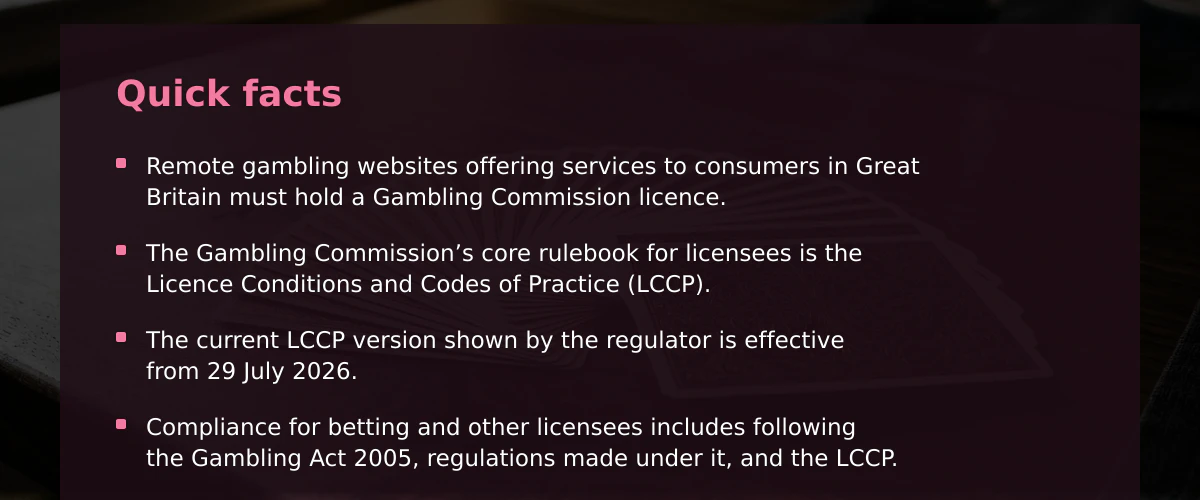
Possessing a licence is a legal requirement, yet the concept of safety encompasses a broader spectrum of operational habits and technical features. A licensed site has met the minimum legal threshold to operate, but a safe environment is one where the operator actively manages risk and promotes responsible habits. The regulator sets the floor, but the most secure platforms often implement additional layers of encryption and two-factor authentication to protect user data. It is important for consumers to recognise that while every legal site is licensed, the quality of their safety tools can vary significantly between brands.
Safety also relates to how an operator handles the psychological risks associated with gambling. A licensed operator might satisfy the law by providing links to support groups, but a safe operator integrates those tools into the user interface to make them easily accessible. This includes the implementation of GamStop, the national self-exclusion scheme that prevents individuals from accessing any licensed gambling site in Great Britain once they have registered for the service. The distinction lies in the transition from mere legal compliance to the active preservation of the player’s well-being and financial stability.
Technical safety involves the protection of payment information and personal identity documents required during verification. In the United Kingdom, operators are prohibited from accepting credit cards, a rule designed to prevent gambling with borrowed money. Instead, safe and licensed platforms rely on secure methods such as debit cards, PayPal, Apple Pay, and Paysafecard. These methods provide a clear audit trail and are subject to their own stringent financial regulations, adding another layer of security to the transaction process for both deposits and withdrawals of winnings.
Mechanisms for player protection
--------------------------------
One of the most effective mechanisms for protecting individuals in the British market is the mandatory implementation of affordability checks. These assessments require operators to monitor spending patterns and, in certain cases, verify that a customer has the financial means to sustain their level of play. By intervening early when spending becomes inconsistent with a customer's known profile, operators can prevent the escalation of financial harm. This proactive approach marks a shift from reactive moderation to a preventive strategy that safeguards the long-term interests of the consumer.
Financial limits provide a practical way for individuals to manage their interaction with jackpot games casino software. Users can set daily, weekly, or monthly deposit limits that cannot be increased without a cooling-off period, usually lasting 24 hours. This delay prevents impulsive decisions made in the heat of a gaming session, allowing for a more considered approach to bankroll management. Time-out features allow players to take a short break from the platform, ranging from one day to six weeks, during which the account remains inaccessible for any form of wagering.
> The most effective way to maintain control is to view the various limiting tools not as restrictions, but as a framework for personal financial discipline.
Self-exclusion remains the strongest form of protection available to those who feel their gambling is becoming problematic. By joining the GamStop registry, a person is barred from all licensed gambling businesses in Great Britain for a chosen period of six months, one year, or five years. Operators are legally required to cross-reference their database with the GamStop list and prevent any registered individual from logging in or creating a new account. This collective defence mechanism ensures that a decision to stop gambling is respected across the entire regulated industry rather than just at a single website.
Operational limits on slot games
--------------------------------
The British government and the regulator have introduced specific limits on online slot stakes to reduce the risk of rapid financial losses. As of 9 April 2026, a general stake cap of £5 per spin was implemented for all adults using online slots. This measure was introduced to bring the online environment closer to the restrictions found in physical gaming centres and betting shops. By limiting the amount that can be wagered in a single round, the regulator aims to slow down the pace of play and lower the potential for significant, sudden harm to a person's finances.
Younger adults are subject to even tighter controls due to data suggesting they may be more susceptible to risk-taking behaviour. For individuals aged 18 to 24, the online slots stake limit is set at £2 per spin, a rule that went live on 21 May 2026. This age-specific restriction reflects a targeted approach to regulation, acknowledging that different demographics require different levels of protection. Operators must verify the age of every customer before allowing them to gamble, ensuring that these limits are applied correctly from the moment an account is opened.
* The £5 stake limit applies to all slot games for players aged 25 and over.
* A lower limit of £2 is strictly enforced for those in the 18 to 24 age bracket.
* Operators must implement these limits at the software level to prevent any circumvention.
* Stake caps are part of a broader effort to modernise the Gambling Act 2005 for the digital age.
These limits do not affect the potential size of a progressive jackpot, which is built up by small contributions from every wager made across a network. However, they do change how quickly a player can exhaust their balance while pursuing such prizes. Compliance teams at gambling firms must ensure that their game libraries are configured to reject any wager exceeding these statutory caps. Failure to do so can result in significant regulatory penalties and the potential loss of the firm’s operating licence.
Payment security and verification
---------------------------------
The verification process, often referred to as Know Your Customer (KYC), is a vital component of the security framework in Great Britain. Before a withdrawal can be processed, and often before a deposit is even allowed, the operator must confirm the identity, age, and address of the user. This is typically done by requesting copies of a passport or driving licence, along with a recent utility bill or bank statement. These checks are designed to prevent money laundering and ensure that the person using the account is exactly who they claim to be, thereby reducing the risk of fraud.
Payment methods in the United Kingdom are chosen for their reliability and their adherence to local financial laws. Debit cards issued by British banks are the most common way to fund an account, providing a direct and secure link to the user’s personal funds. E-wallets like PayPal and Apple Pay offer an additional layer of privacy, as the user’s banking details are not shared directly with the gambling operator. For those who prefer a voucher-based system, Paysafecard allows for deposits without the need for a bank account, though withdrawals usually require a different method to return the funds to the player.
Safe play involves understanding how money moves in and out of a [space slots](https://space-slots.com/) or any other gaming environment regulated by the Commission. The ban on credit cards, which has been in place for several years, is a cornerstone of this financial safety policy. It ensures that individuals only gamble with money they already possess, rather than accumulating debt that may be difficult to repay. Operators must also ensure that all transactions are encrypted using Industry Standard Secure Socket Layer (SSL) technology to protect against interception by unauthorised third parties.
Industry trends and statistics
------------------------------
The scale of the British gambling industry is reflected in the official figures released by the regulator. In the year ending March 2026, the total industry Gross Gambling Yield reached £16.8 billion, highlighting the significant role the sector plays in the national economy. Within this, the online segment accounted for £7.8 billion, demonstrating the continued shift toward digital platforms. As technology improves and mobile accessibility increases, more people are engaging with casino games, betting on horse racing, and following football markets through their smartphones and tablets.
Recent quarterly data from July to September 2026 shows that the market continues to expand, with online yield up 8% compared to the previous year. This growth is driven by a record-breaking 26.1 billion bets and spins during that three-month period. The number of active accounts also remains high; as of March 2026, there were over 4.9 million active slots accounts and approximately 2.6 million accounts dedicated to other casino gaming. These statistics illustrate the vast amount of data that the Gambling Commission must monitor to ensure that all operators are behaving responsibly and within the law.
1. Total industry Gross Gambling Yield reached £16.8 billion in early 2026.
2. Online bets and spins peaked at 26.1 billion in a single quarter of late 2026.
3. Over 6.2 million active accounts were recorded for real-event betting by March 2026.
4. Online casino gaming yield continues to grow at a steady annual rate of roughly 8%.
Monitoring these trends allows the regulator to identify areas where new rules might be needed. For example, the surge in online activity led directly to the implementation of the stake caps and the tightening of affordability check requirements. By staying informed about the volume of play and the types of games that are most popular, the Commission can tailor its enforcement actions to the areas of greatest potential risk. This data-driven approach is essential for maintaining a balanced market that allows for commercial success while prioritising the safety of the millions of people who participate.
Consumer rights and transparency
--------------------------------
Transparency is a requirement for all casino premises and online platforms operating in Great Britain. Operators must display the rules of each game in a prominent place, ensuring that players understand the odds and the mechanics of the jackpot before they commit any funds. This includes providing clear information on how a jackpot is triggered and what the expected return to the player will be over a long period. In physical venues, this information is often provided through leaflets or posters, while online sites must provide a dedicated help or info section for every title in their library.
British players benefit from the fact that gambling winnings are generally not taxed as personal income. The tax burden falls on the operators, who pay a Remote Gaming Duty to the government based on their profits. This means that when a jackpot is won, the amount credited to the player’s account is the full amount advertised, without any deductions for the Inland Revenue. This tax-free status for winners is a long-standing feature of the British system, though it places a greater responsibility on the state to collect revenue directly from the businesses providing the service.
Rights also extend to the fair treatment of bonuses and promotions. The regulator requires that all terms and conditions are presented clearly, without hidden clauses that might unfairly prevent a player from withdrawing their own money. If a site offers a bonus, the wagering requirements must be stated upfront, and the operator cannot change these terms after the player has started using the funds. This level of transparency is enforced to prevent misleading advertising and to ensure that the relationship between the consumer and the business is based on clear, enforceable agreements.
Observations and findings
-------------------------
The regulatory landscape in Great Britain is defined by a rigorous focus on consumer protection and financial integrity. Through the Gambling Commission, the state ensures that all jackpot games casino activities are conducted under a strict set of rules that prioritise the safety of the player. The implementation of stake caps, the ban on credit cards, and the mandatory use of schemes like GamStop create a multi-layered defence against gambling-related harm. These measures, combined with the technical verification of game fairness, ensure that the market remains one of the most reputable in the world.
Maintaining a safe environment requires constant vigilance from both the regulator and the operators. While a licence provides the legal basis for operation, true safety is found in the robust application of responsible gaming tools and the transparent handling of player funds. The growth of the industry, as shown by recent yield statistics, proves that a well-regulated market can thrive while still offering high levels of protection to its participants. Consumers are encouraged to always verify the licensing status of a platform and to make full use of the available tools to manage their gaming habits effectively.


